
The creation of my Americana show was serendipitous in many different ways. I have been involved in American crafts using both traditional and untraditional means for more than 20 years. Throughout those years, I have designed dozens of different collections based on the American West and Southwest. When I think of Americana cowboys, quilts, and desert landscapes come to mind. I wanted to bring the core of this classic American genre to life with my “Americana” series. The question then became: How do I modernize the designs and make them a true Stephen Wilson series?
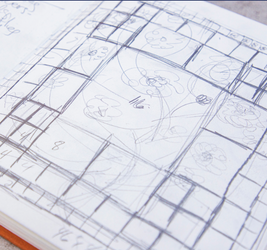
Each piece begins with a concept and a sketch. Since there is a lot of planning involved in the final artwork, this is an integral part of the process. The initial sketches contain information on content, as well as information on fabric choices and structural details.
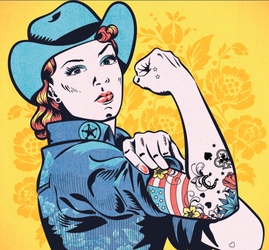
Once the sketch for the final artwork is ready for production, a more detailed drawing is created using digital drafting tools. Since the sewing and embroidery elements of each piece are extremely time-consuming and detailed, a paper maquette of the work, all of the notes, and instructions for the piece are written on the mockups and blueprints.
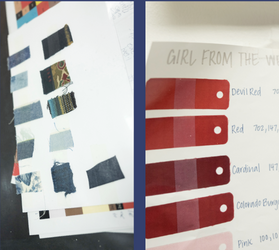
The fabric options include everything from leather, to Chanel boucle, to Hermès silk scarves. Fashion is highly influential in Stephen’s work, therefore selecting the right fabric for the piece is essential. Once chosen, each piece of fabric is precision-cut on a laser cutter.
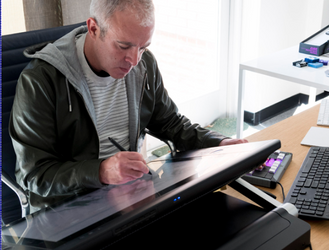
For over 20 years, Stephen has practiced hand-embroidery on a computer. Using specialized software and a digital stylus, he hand-draws each stitch, determining its length, layering, color changes, and machine speed. To Stephen, digitizing is like painting with thread. The machine then stitches exactly what he has created, while the software simply plots the points.
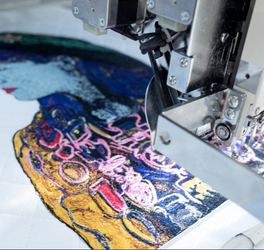
The studio has over 25 state-of-the-art embroidery machines that stitch the designs at up to 1,000 stitches a minute. Every design is loaded into the machine to be stitched, and each piece of fabric is placed onto specialized backing, aligned, and embroidered. Some of the designs are especially challenging to make. Each element is stitched one at a time, so just imagine how long a finished piece with hundreds of elements takes to complete!
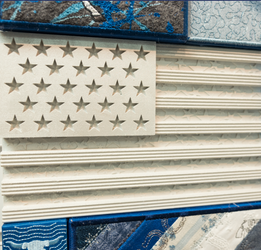
There is more than fabric and embroidery used in Stephen’s pieces. 3D printing, painting, laser cutting, and engraving also play prominent roles, especially in his sculptures. Every element of his work is created in his Charlotte studio, including the 3D-printed elements.
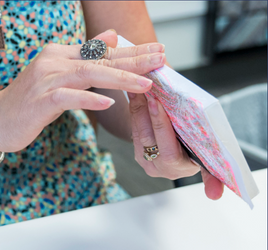
The fabrication of a piece is extremely important; not only does the finished work of art have to look amazing, it also needs to last forever. Hundreds of hours of research and development have been put into creating the artwork, and the finished pieces are built to last. Each piece of fabric, once it is embroidered, is meticulously mounted on precision-cut wood blocks and assembled together like a giant jigsaw puzzle.
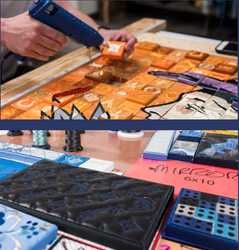
Once the hundreds of elements are fabricated, they are placed together to form the final image. During this final phase, chance often shows up and the piece changes. The end result of these processes is often unexpected, no matter how carefully planned. For Stephen, the most rewarding part of creating art is that surprise at the end when all of the elements come together.


This is a piece from Americana, each of the pieces were made individually and then mounted around individual wood blocks. I used twill for these blocks, they were digitized as 361 unique designs to form the scene.

This is a piece from Americana, each of the pieces were made individually and then mounted around individual wood blocks. I used twill for these blocks, they were digitized as 361 unique designs to form the scene.

This is a piece from Americana, each of the pieces were made individually and then mounted around individual wood blocks. The blacks were laser cut for exact measurements.The fabrics are all assorted and up-cycled.

This is a piece from Americana, each of the pieces were made individually and then mounted around individual wood blocks. The blacks were laser cut for exact measurements.The fabrics are all assorted and up-cycled.


Size - 28"x22"
Mixed Media

Framed size - 60"x40"
Mixed Media


